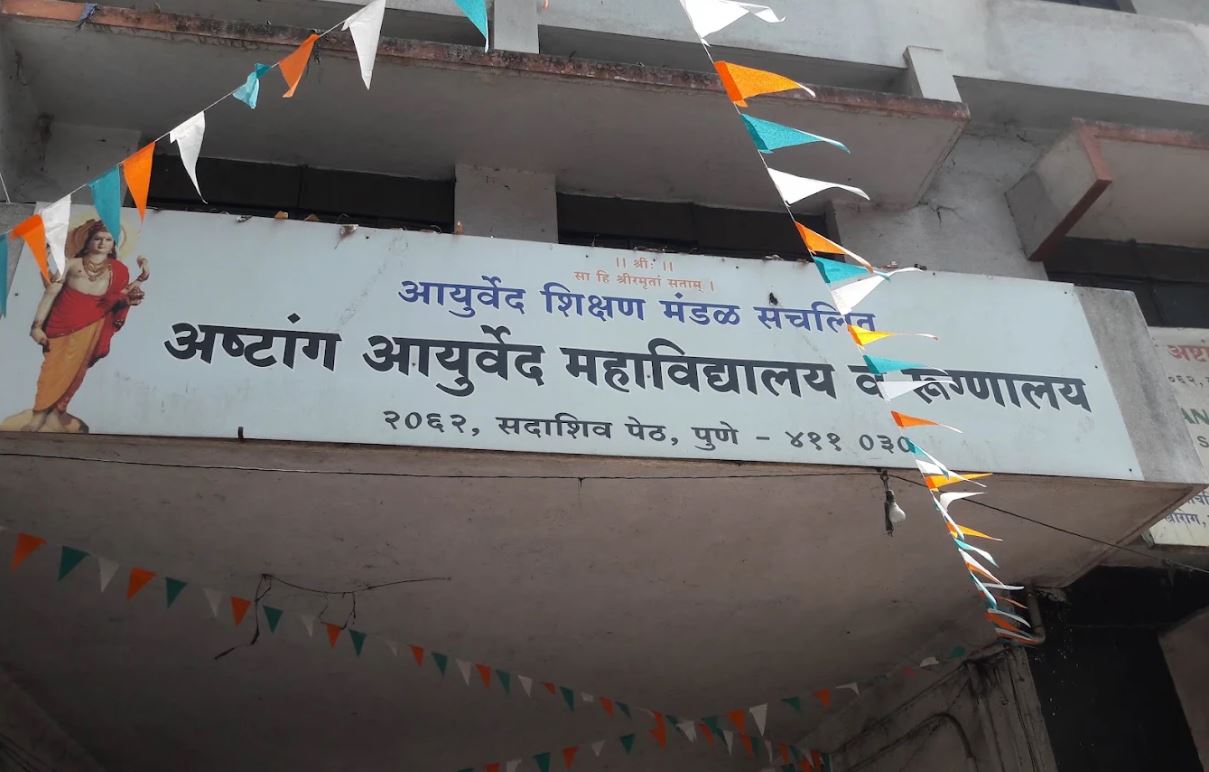
If you are shortlisting Ayurvedic colleges in Maharashtra for your NEET counselling, Ashtang Ayurved Mahavidyalaya in Pune should be on your radar for one specific reason. It is one of the oldest Ayurvedic institutions in the country, founded in 1936 by Vaidya Haribhau Paranjape and a group of freedom-era educators under the Ayurved Shikshan Mandal.
This is not a college that added Ayurveda as a course offering. It was built to propagate the discipline when institutional Ayurvedic education was still finding its footing in India. The campus sits in Sadashiv Peth, in the heart of Pune, and it has been training vaidyas from that same address for close to nine decades.
Here is what you need to know before you fill in your Maharashtra AYUSH counselling choices.
Ashtang Ayurved Mahavidyalaya Overview
| Parameter | Details |
|---|---|
| Full Name | Ayurved Shikshan Mandal’s Ashtang Ayurved Mahavidyalaya & Rugnalaya |
| Established | 1936 |
| Founders | Vaidya Haribhau Paranjape, Vaidya Ganesh Shridhar Mulaye, and Pandit Ramchandra Dattatreya Kinjawadekar |
| Managed By | Ayurved Shikshan Mandal |
| Location | 2062, Opposite N M V Girls High School, Paranjape Chowk, Sadashiv Peth, Pune 411030 |
| Affiliating University | Maharashtra University of Health Sciences (MUHS), Nashik |
| Regulatory Approval | National Commission for Indian System of Medicine (NCISM) |
| College Type | Private |
| BAMS Seats (2025-26) | 60 seats (75 seats including EWS) as per NCISM permission |
| PG Seats | MD and MS programmes in multiple specialities |
| Admission Route | NEET-UG followed by Maharashtra AYUSH counselling |
| Teaching Hospital | Ashtang Ayurved Rugnalaya with OPD, IPD, and Panchakarma unit |
| Herbal Garden | 200+ medicinal species |
| Campus Size | Approximately 1 acre |
Establishment, Mission, and the Location Reality
The college was founded in April 1936 by Vaidya Haribhau Paranjape, Vaidya Ganesh Shridhar Mulaye, and Pandit Ramchandra Dattatreya Kinjawadekar. The institution is registered under the Indian Society Registration Act XXI of 1860 and the Bombay Public Trust Act of 1952. The founding mission was straightforward: to help Ayurvedic education grow and develop, and to serve poor and needy patients through Ayurveda.
The college describes itself as an institution that researches various aspects of Ayurveda and aims to set up a Centre of Excellence. The stated vision is to cultivate skilled Ayurvedic practitioners who contribute innovatively to holistic health and wellness, and to emerge as a centre of excellence in Ayurvedic education, research, and patient care.
The location is central Pune, and you need to understand what that means in practice. The campus is in Sadashiv Peth, opposite N M V Girls High School at Paranjape Chowk. Pune International Airport is roughly 12 km away, and the Deccan Gymkhana metro station is the nearest rapid transit stop.
This is not a suburban campus with large grounds. The campus size is approximately 1 acre, and the college building, hospital, and academic departments sit within a dense urban neighbourhood. For a student, the advantage is connectivity and access to Pune’s clinical and educational ecosystem.
The disadvantage is that you will not get the sprawling green campus experience that some private institutions advertise.
BAMS Seats, University Affiliation, and the Regulatory Details
For the 2025-26 academic session, the NCISM has granted Extended Permission with an intake capacity of 60 seats (75 seats including EWS) in the UG (BAMS) course under section 28 of the NCISM Act, 2020. You will see 50 seats quoted on several third-party aggregator pages and college comparison sites.
Those figures reflect older intake cycles or incomplete data. The NCISM permission for the current session is the authoritative source, and it places the sanctioned intake at 60 seats, with 75 seats when EWS is included.
I still tell students to verify the seat matrix on the State CET Cell portal for their specific counselling year, because quota treatment and permission status can shift between sessions.
The college is affiliated to Maharashtra University of Health Sciences (MUHS), Nashik, and approved by NCISM. The BAMS programme runs for five and a half years, including four and a half years of academics and a one-year compulsory rotating internship.
Admission is strictly through NEET-UG followed by Maharashtra AYUSH counselling, with seats allotted on merit, category, and counselling round. At the postgraduate level, the college offers MD and MS programmes in disciplines including Samhita and Siddhanta, Rachana Sharira, and Streeroga Prasuti Tantra, along with PhD research facilities.
For an undergraduate, the presence of PG departments signals faculty depth, even if you are not enrolling in those programmes yourself.
Facilities:
The hospital is the centrepiece of the learning experience, and it is functional rather than expansive. The attached Ashtang Ayurved Rugnalaya runs well-equipped OPDs and IPDs with a special Panchakarma unit.
The hospital provides clinical training across specialty Ayurvedic services, and the patient flow supports practical learning for the BAMS batch. The campus also maintains a herbal garden with more than 200 medicinal species, which is used for botanical study and Dravyaguna practicals.
Some descriptions mention over 125 plants and others cite 200+ species, so the exact count varies by source, but the garden is an active academic resource rather than a decorative patch.
The academic infrastructure includes departmental laboratories, a central library, an auditorium, and a museum. The college lists departments in Samhita Siddhanta, Rachana Sharira, Sharir Kriya, Dravyaguna, Rasashastra and Bhaishajya Kalpana, Rognidan, Swasthavritta, Agadtantra, Streeroga Prasutitantra, Kaumarbhritya, Kayachikitsa, Shalya Tantra, and Shalakyatantra.
The library has been described by students as small but adequate for finding the books needed for reading.
The honest part of this section is the infrastructure review. Verified student feedback describes classrooms as small and poorly furnished, with uncomfortable benches and no Wi-Fi or reliable network coverage on campus. One review states that the library is too small, and another notes that there is no proper mess or hostel for the college, although PG accommodation and private hostels are available in the surrounding Sadashiv Peth area.
The campus has a badminton court, but students describe it as poorly maintained. The canteen facility is listed in official infrastructure disclosures, but student reviews say there is no proper canteen on campus. These are not minor details when you are planning five and a half years of daily life.
Sadashiv Peth is a dense residential and commercial neighbourhood, and the availability of outside food and accommodation is high, but you will be arranging those logistics yourself rather than relying on a fully residential campus.
Why Choose Ashtang Ayurved Mahavidyalaya?
Here is the answer I give to students who ask whether this college deserves a slot on their preference list. You choose Ashtang Ayurved if you want a heritage institution in the heart of Pune with a nine-decade track record, a functioning Panchakarma hospital, and a MUHS affiliation, at a fee structure that sits at the moderate end of the private Ayurvedic market.
The college was founded in 1936, which means its academic systems, faculty networks, and hospital protocols have had generations to stabilise. The 60-seat BAMS intake keeps the batch small, and a small batch against a hospital with OPD, IPD, and Panchakarma services means you are not competing with a crowd for clinical material.
The MUHS affiliation and NCISM permission keep your degree within a recognised regulatory and university framework. The herbal garden with over 200 species supports Dravyaguna learning in a way that textbook study cannot replicate. And the Sadashiv Peth location places you inside Pune’s educational and clinical geography, with the railway station, airport, and metro within reach.
If your NEET rank places you in the range where a Pune-based private Ayurvedic college is realistic, and you value legacy and clinical proximity over campus gloss, this institution earns serious consideration. What it does not offer is modern classroom infrastructure, a residential campus, or a canteen and hostel setup that matches what larger private institutions provide.
You are choosing heritage, hospital access, and fee rationality over facilities. That trade-off works for a specific kind of student, and it is worth being honest about which kind you are.
Fees and Admission:
Fee figures for this college vary by source and quota. Door2College lists the government/state quota fee at approximately ₹80,000 per year and the management quota fee at approximately ₹2.5 lakh per year, with annual fees revised by the Fee Regulating Authority.
Shiksha lists total BAMS tuition fees of around ₹2.54 lakh, while Careers360 cites total BAMS fees of ₹2.49 lakh and a tuition fee component of ₹42,340 with a one-time admission fee of the same amount. Moksh16 lists a tuition fee of ₹45,700 for 2025-26, and Shikshababa quotes ₹47,500. These numbers do not reconcile, and the gap is too wide to ignore. Treat every third-party figure as indicative.
The only number that matters is the fee order applicable to your allotment year and category, issued through the Maharashtra AYUSH counselling authority or the college admission office.
For a private Ayurvedic college, the state-quota fee is typically the lower end of the range, but confirm it before you build your budget. Hostel and mess costs, if you arrange them privately in Sadashiv Peth, will add significantly to the annual outlay.
Eligibility follows the standard NEET framework: 10+2 with Physics, Chemistry, Biology, and English, a valid NEET-UG score, and the minimum qualifying percentile for your category. NEET cutoff trends for the general category show a closing rank of around 142,190 in 2025, with OBC closing ranks in the 160,352 range and EWS closing around 77,141. These are historical trends, not guarantees.
Admission runs through Maharashtra AYUSH counselling on the State CET Cell portal. Keep your documents ready before counselling opens, including your NEET admit card and scorecard, 10+2 marksheets, domicile certificate, caste or EWS certificate if applicable, and the standard medical and migration documents required at reporting.
FAQs: Straight Answers for BAMS Aspirants
1. When was Ashtang Ayurved Mahavidyalaya established?
The college was established in April 1936 by Vaidya Haribhau Paranjape, Vaidya Ganesh Shridhar Mulaye, and Pandit Ramchandra Dattatreya Kinjawadekar under the Ayurved Shikshan Mandal.
2. How many BAMS seats are available at this college?
For the 2025–26 academic session, NCISM granted permission for 60 BAMS seats, with the stated intake reaching 75 seats including EWS. Some older sources mention 50 seats, but students should refer to the latest NCISM permission order and official counselling seat matrix for the applicable admission year.
3. Which university is the college affiliated to?
The college is affiliated to Maharashtra University of Health Sciences (MUHS), Nashik, and approved by the National Commission for Indian System of Medicine (NCISM).
4. Is Ashtang Ayurved a government or private college?
Ashtang Ayurved Mahavidyalaya is a private institution managed by the Ayurved Shikshan Mandal trust. It is not a government or government-aided college.
5. What hospital facilities are available for clinical training?
The attached Ashtang Ayurved Rugnalaya provides OPD and IPD services, including a dedicated Panchakarma unit and other specialty Ayurvedic services. These facilities support clinical exposure and practical training for BAMS students.
6. Is a hostel facility available at the college?
Although official disclosures list hostel facilities, student reviews report that proper hostel and mess facilities may not be available on campus. Many students arrange PG accommodation or private hostel stays in the surrounding Sadashiv Peth area. Confirm current accommodation availability directly with the college.
7. What is the fee structure for the BAMS programme?
Published estimates for the total BAMS programme fee range from approximately ₹2.49 lakh to ₹2.54 lakh. Reported annual fees are around ₹80,000 for the State Quota and approximately ₹2.5 lakh for the Management Quota. These are indicative figures; verify the latest approved fee order for your category and admission year.
8. Does the college have a herbal garden?
Yes. The campus maintains a herbal garden with more than 200 medicinal plant species. It is used for Dravyaguna practicals, medicinal plant identification, and botanical study.
Ashtang Ayurved Mahavidyalaya is not a campus you choose for modern classrooms or a residential experience. You choose it for the 1936 heritage, the Sadashiv Peth location, the 60-seat BAMS intake, the Panchakarma hospital, and a MUHS affiliation at a moderate private fee. The college has been training vaidyas from the same Pune address for close to nine decades, and that continuity is worth something.
Verify the current-year fee order, the seat matrix, and the hostel reality before you report.
Then take the short ride from Pune Junction to Sadashiv Peth, walk through the hospital OPD, and stand in the herbal garden. The patient flow and the plant labels will tell you more about whether this college fits you than any brochure ever could.