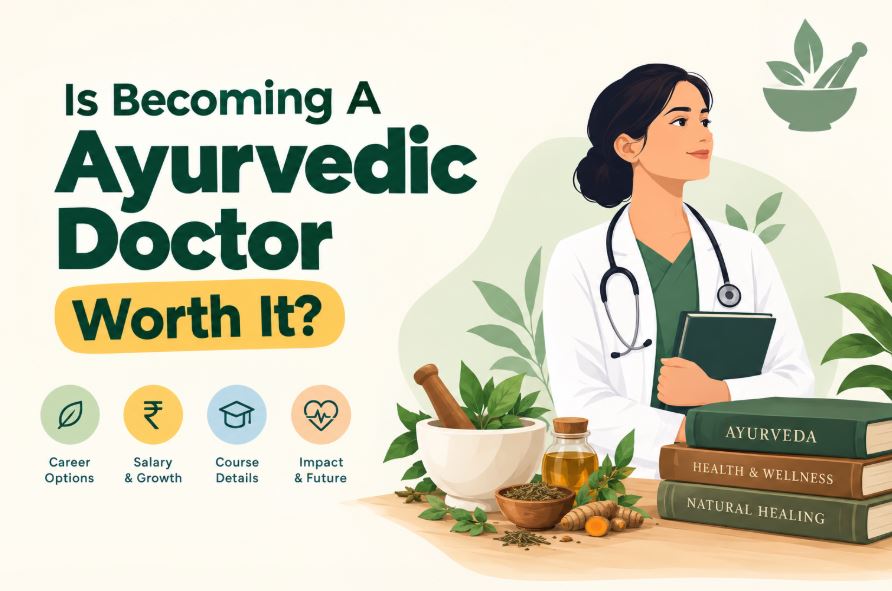
Is becoming an Ayurvedic doctor worth it in India? The short answer is yes, but only if Ayurveda genuinely interests you and you are prepared to build your career beyond simply earning a BAMS degree.
A Bachelor of Ayurvedic Medicine and Surgery (BAMS) is a professional undergraduate medical programme focused on Ayurveda, while also covering anatomy, physiology, pathology, diagnostics, medicine, surgery, obstetrics, paediatrics, emergency care and clinical training.
The course takes 5.5 years, including academic training and a compulsory one-year internship. The internship is designed to move students from classroom learning into supervised clinical practice.
But here is the important part. A BAMS degree alone does not guarantee a high-paying career.
Your college, clinical exposure, postgraduate education, practical skills, location, communication ability and willingness to build expertise can have a major impact on what happens after graduation. So, is becoming an Ayurvedic doctor worth it? Let’s look at the facts.
What Does an Ayurvedic Doctor Actually Do?
An Ayurvedic doctor is trained to practise within the Ayurveda system of medicine.
The BAMS curriculum goes far beyond medicinal plants. Students learn Ayurvedic concepts alongside subjects such as anatomy, physiology, pathology, pharmacology-related concepts, diagnosis, internal medicine, Panchakarma, surgery, ENT and ophthalmology, obstetrics and gynaecology, paediatrics, toxicology and emergency care.
During internship, students gain supervised exposure to clinical environments and learn about patient care, medical records, communication, professional ethics and hospital procedures. NCISM describes the internship as an important transition from academic learning to hands-on clinical practice.
After completing the required education and registration requirements, graduates can pursue careers in clinical practice, hospitals, government services, education, research, pharmaceuticals, wellness and other Ayurveda-related areas.
The National Commission for Indian System of Medicine, or NCISM, is the statutory regulatory body responsible for standards related to Indian System of Medicine education and the national medical register.
Why Is Ayurveda Becoming a Career Option?
Interest in traditional medicine and wellness has created opportunities beyond the traditional neighbourhood Ayurveda clinic.
The Ministry of Ayush continues to support Ayurveda and other Indian systems of medicine through education, healthcare programmes, research and institutional development. Its current website also lists BAMS among the undergraduate programmes covered by its national-level guidelines.
Research is another important part of the ecosystem.
The Ministry of Ayush operates an Ayush Research Portal that provides access to curated research information covering Ayurveda and other AYUSH systems.
This does not mean every BAMS graduate will automatically find a lucrative job. It means the profession has a broader ecosystem than it did when Ayurveda careers were largely associated with private clinics.
For students who are interested in traditional medicine, preventive healthcare, lifestyle management and long-term patient care, that broader ecosystem can create interesting career possibilities.
Career Options After BAMS
One of the biggest advantages of BAMS is that you do not have to follow a single career path.
1. Private Ayurvedic Practice
Private practice remains one of the most direct options. You can work in an established clinic first and eventually build your own practice. But successful private practice takes time.
Your reputation depends on clinical competence, patient communication, ethical practice, results, referrals and trust. Location also matters.
A new graduate should not expect a large patient base from day one. Think of private practice as a business and professional career that you build over several years, not as an instant source of high income.
2. Ayurveda Hospitals and Healthcare Centres
BAMS graduates can work as doctors or medical officers in Ayurveda hospitals and healthcare organisations, subject to applicable registration and recruitment requirements.
Government recruitment notices demonstrate that BAMS graduates with recognised qualifications and appropriate registration can be eligible for Medical Officer positions. For example, Ministry of Ayush recruitment documentation has specified BAMS and registration requirements for Medical Officer posts.
This makes government and institutional employment an important option for graduates who prefer a structured work environment.
3. Government Jobs
Government employment can be attractive because it may provide greater stability, defined responsibilities and structured career progression.
Opportunities can occur through state AYUSH departments, government hospitals, national programmes and other public-sector institutions, depending on vacancies and eligibility rules. The key point is that government recruitment is competitive.
A BAMS degree does not mean you automatically get a government job. You still have to meet the specific eligibility criteria and compete through the applicable recruitment process.
4. Postgraduate Specialisation
If you want to become more specialised, postgraduate education can significantly expand your professional options.
A BAMS graduate can consider MD/MS Ayurveda and related postgraduate pathways, depending on eligibility, entrance requirements and the specialisation offered. Postgraduate study can be particularly valuable for students interested in:
- Teaching
- Specialist clinical practice
- Research
- Academic careers
- Senior hospital positions
- Developing expertise in a specific Ayurvedic discipline
If your long-term goal is to become a recognised specialist or enter academia, planning for postgraduate education early can be a smart move.
5. Teaching and Academia
Teaching is another career path. With the required postgraduate qualification and other applicable criteria, Ayurveda graduates can pursue academic roles in Ayurveda colleges.
The Ministry of Ayush’s recruitment material, for example, lists Assistant Professor positions across Ayurveda disciplines and requires a recognised postgraduate Ayurveda qualification for such roles.
This makes higher education particularly important for students who want a long-term academic career.
6. Research
Research is an increasingly relevant option for graduates who enjoy science, clinical studies and evidence generation. You could work in areas involving:
- Ayurvedic clinical research
- Pharmacological research
- Medicinal plants
- Drug development
- Public health
- Clinical documentation
- Research organisations
- Academic institutions
NCISM itself identifies encouraging medical professionals to adopt current medical research and contribute to research as one of its objectives.
7. Pharmaceutical and Wellness Industry
The Ayurveda ecosystem also includes pharmaceutical companies, wellness organisations, product development and healthcare businesses.
BAMS graduates may find roles related to medical content, product knowledge, clinical support, research, quality-related functions, education and other specialised areas, depending on their qualifications and skills.
This is particularly relevant for graduates who enjoy healthcare but do not want to spend their entire career treating patients in a clinic.
What About Salary After BAMS?
This is where you need to be realistic. There is no single BAMS salary. Your earnings can vary significantly based on:
- Government or private employment
- Experience
- City
- Clinical skills
- Specialisation
- Employer
- Patient volume
- Private practice
- Additional qualifications
- Business and communication skills
Fresh graduates often start at relatively modest salaries, particularly in private-sector jobs. With experience, postgraduate qualifications, a strong reputation or an established practice, earning potential can improve substantially.
However, online articles that promise every BAMS doctor a specific high salary should be treated carefully.
Your first salary is not the same thing as your long-term earning potential.
For example, a government Medical Officer position may have a defined pay structure, while a private practitioner may have highly variable income. Ministry of Ayush recruitment documentation has listed a ₹56,100 basic pay figure for certain Medical Officer posts, but that figure belongs to a specific recruitment framework and should not be treated as the universal salary for every BAMS graduate.
Is BAMS Better Than MBBS?
This is the wrong question. A better question is: Which medical system and career path do you actually want to pursue?
MBBS and BAMS are different professional pathways with different educational frameworks and areas of practice.
If your primary goal is conventional modern medicine and the career pathway associated with MBBS, you should pursue MBBS rather than choosing BAMS simply because you did not get an MBBS seat. On the other hand, if you genuinely want to study and practise Ayurveda, BAMS can be a meaningful professional route.
Do not choose BAMS as a backup. Choose it because you want to become an Ayurvedic physician. That distinction can have a huge impact on your motivation over the next five and a half years.
The Biggest Advantages of Becoming an Ayurvedic Doctor
There are several reasons students choose this profession.
1. A recognised professional medical education
BAMS is a regulated undergraduate programme within India’s Indian System of Medicine framework. NCISM is responsible for medical education standards and the national register for Indian System of Medicine.
2. Multiple career paths
You can explore clinical practice, hospitals, government employment, postgraduate education, teaching, research and industry.
3. Opportunity to build your own practice
Unlike a career that is completely dependent on an employer, private practice can eventually allow you to build your own patient base and professional identity.
4. Growing research ecosystem
Government-supported research infrastructure and dedicated Ayurveda research initiatives provide opportunities for graduates who want to explore evidence and innovation.
5. Long-term professional growth
Your BAMS degree is the beginning, not necessarily the end, of your professional education.
What Are the Challenges?
A realistic career guide should discuss the disadvantages too.
Income may be modest initially
Do not expect a six-figure monthly income immediately after graduation. Your first few years may involve relatively modest salaries while you gain clinical experience.
Building a private practice takes time
Patients do not automatically arrive because you have a BAMS degree. You need trust, communication skills, clinical competence and patience.
Competition exists
You will compete with other BAMS graduates as well as professionals from other healthcare disciplines. Standing out requires a genuine skill advantage.
Postgraduate education may become important
If you want to enter teaching, specialise or pursue certain senior positions, additional qualifications can become important.
Clinical responsibility is real
BAMS is not an easy alternative to studying medicine. The curriculum involves extensive academic and clinical training, and NCISM’s internship framework specifically focuses on developing clinical competence, professional behaviour, communication and ethical practice.
Who Should Become an Ayurvedic Doctor?
BAMS may be a good fit if you:
- Are genuinely interested in Ayurveda
- Enjoy studying biology and medical subjects
- Like interacting with patients
- Are interested in preventive and lifestyle-based healthcare
- Want the possibility of running your own clinic
- Are willing to develop clinical skills over time
- Are comfortable with continuous learning
- May want to pursue postgraduate education
It may not be the right choice if your only reason is that you could not secure an MBBS seat. That is one of the biggest mistakes students can make.
So, Is Becoming an Ayurvedic Doctor Worth It?
Yes, becoming an Ayurvedic doctor can be worth it. But the degree is not a shortcut to success.
BAMS gives you a professional foundation. What you do with that foundation determines much of your career.
If you build strong clinical skills, gain meaningful hospital exposure, communicate well with patients, keep learning and consider specialisation when appropriate, your opportunities can expand considerably.
The profession also gives you several directions to explore. You can become a clinician, build a private practice, work in a hospital, pursue government opportunities, specialise, teach, conduct research or explore the Ayurveda and wellness industry.
The most important decision comes before admission. Ask yourself whether you actually want to practise Ayurveda. If the answer is yes, BAMS can be a rewarding long-term career.
If the answer is no, choosing it only because it appears to be an alternative to MBBS may leave you frustrated.
Final Verdict
BAMS is worth considering if you have genuine interest in Ayurveda and are prepared to build expertise over time.
Think beyond the starting salary. Think about the kind of doctor you want to become, the patients you want to serve, whether you want your own practice, whether you are willing to pursue postgraduate education and whether you enjoy continuous learning.
That is the real question behind “Is becoming an Ayurvedic doctor worth it?” For the right student, the answer can be yes.