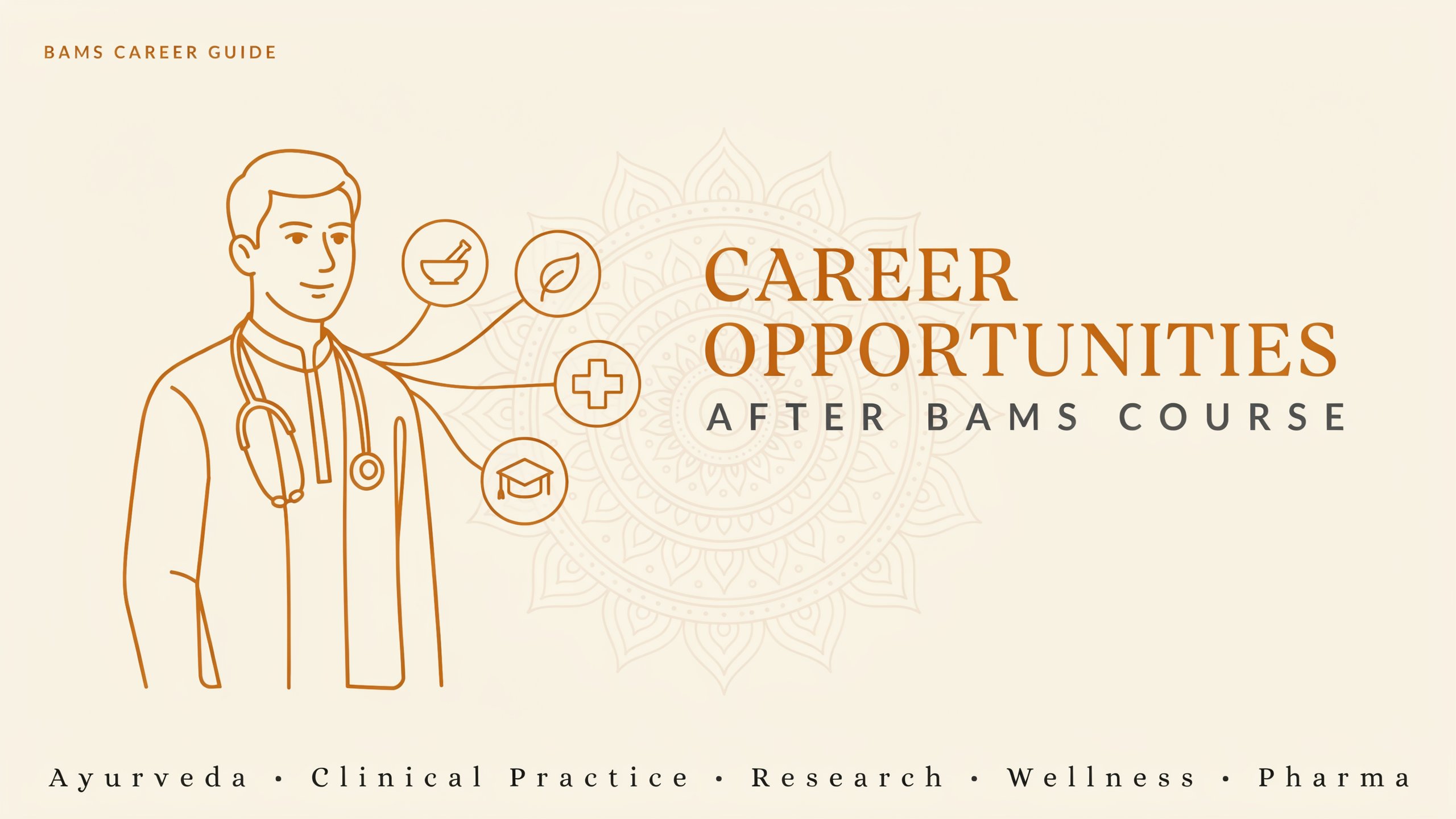
A BAMS degree can lead to more than a traditional Ayurvedic clinic. Graduates can explore clinical practice, hospitals, government healthcare, research, education, pharmaceuticals, and wellness businesses.
The important question is not just, “What can I do after BAMS?” It is, “Which career path matches my skills, interests, and long-term goals?” Some options offer a relatively predictable salary, while others can provide higher earning potential through specialization, experience, or entrepreneurship.
Career Opportunities After BAMS: A Practical Guide for Students
BAMS, or Bachelor of Ayurvedic Medicine and Surgery, is a professional medical degree that prepares students for careers in Ayurvedic healthcare. But completing the course does not mean every graduate must follow the same path.
After BAMS, you can work as an Ayurvedic physician, prepare for government medical officer recruitment, pursue MD or MS in Ayurveda, enter research, join the pharmaceutical industry, or build your own healthcare practice. The right choice depends on your clinical interests, financial goals, and willingness to pursue further education.
Recommended Read: Santushti Ayurvedic College, Varanasi
Here is a practical look at the main career opportunities after BAMS, including the earning potential and qualifications involved.
1. Ayurvedic Doctor or Clinical Practitioner
Clinical practice is one of the most direct career options after BAMS. Graduates can work in Ayurvedic hospitals, private clinics, wellness centres, or establish their own practice, subject to applicable registration and professional regulations.
Common areas of practice include:
- General Ayurvedic consultation
- Panchakarma
- Ayurvedic diet and lifestyle counselling
- Preventive healthcare
- Women’s and children’s healthcare
- Skin and other specialty-focused Ayurvedic care
Earning scope: Fresh graduates working in private clinics or hospitals may start around ₹2 lakh to ₹5 lakh per year, although actual offers vary considerably. With experience, a strong patient base, and appropriate specialization, earnings can increase. Private practice has greater upside, but income is not guaranteed and depends on location, reputation, patient volume, and operating costs.
A practical approach is to work with an experienced practitioner before opening an independent clinic. Clinical exposure helps build diagnostic confidence, patient-handling skills, and professional credibility.
2. MD or MS in Ayurveda
For students who want to become specialists, pursue teaching, or access more advanced clinical roles, postgraduate education is an important option.
After BAMS, students can appear for AIAPGET, the entrance examination used for postgraduate AYUSH courses. MD and MS Ayurveda programmes cover specializations such as:
- Kayachikitsa
- Panchakarma
- Shalya Tantra
- Shalakya Tantra
- Prasuti Tantra evam Stri Roga
- Kaumarabhritya
- Dravyaguna
- Rasashastra and Bhaishajya Kalpana
Earning scope: Postgraduate qualification can improve access to specialist, consultant, academic, and research roles. However, salary depends on the employer, specialization, experience, and location. It is better to view MD/MS as a long-term career investment rather than a guaranteed salary increase.
3. Government Jobs and AYUSH Medical Officer
Government healthcare is another important career path after BAMS. Graduates may find opportunities in:
- State AYUSH departments
- Government Ayurvedic hospitals and dispensaries
- National AYUSH Mission programmes
- Public healthcare institutions
- Other government organizations that recruit eligible Ayurvedic medical officers
Recruitment is generally conducted through state public service commissions, health departments, or specific recruitment notifications. Eligibility, registration requirements, and selection procedures vary by post.
Earning scope: Government medical officer salaries follow the relevant pay scale, allowances, and recruitment rules. They can offer more predictable income and employment benefits than many entry-level private roles. However, vacancies are competitive, and students should check official notifications rather than rely on a single advertised salary figure.
4. Ayurvedic Pharmaceutical Industry
The Ayurvedic pharmaceutical sector offers opportunities beyond direct patient treatment. BAMS graduates may work in roles related to:
- Medical affairs
- Product development
- Ayurvedic formulation
- Quality assurance and quality control
- Regulatory support
- Product training
- Medical content and scientific communication
Some graduates also enter sales and marketing roles, particularly where knowledge of Ayurveda helps explain products to healthcare professionals and customers.
Earning scope: Entry-level pharmaceutical roles may offer approximately ₹2.5 lakh to ₹5 lakh annually, while experienced professionals in specialized, managerial, or medical-affairs positions may earn more. These are broad market estimates, not fixed BAMS salary scales.
Students interested in this sector should develop additional skills in documentation, research interpretation, regulatory processes, and communication.
5. Research and Clinical Research
Research is a suitable option for students who enjoy scientific investigation and evidence-based healthcare. BAMS graduates can explore opportunities in:
- Ayurvedic clinical research
- Pharmacological research
- Public health research
- Clinical trials
- Medical documentation
- Research coordination
- Herbal medicine and formulation studies
Organizations such as CCRAS and research institutions working in healthcare may offer project-based opportunities. Some graduates also pursue postgraduate qualifications in clinical research, public health, or related sciences.
Earning scope: Research salaries vary by project, institution, qualification, and experience. Entry-level research positions may begin around ₹3 lakh to ₹6 lakh per year, while experienced research professionals and specialists can earn more. A postgraduate degree or research-focused qualification can improve career progression.
6. Teaching and Academic Careers
Teaching is a strong option for BAMS graduates who enjoy explaining concepts and working in an academic environment. Possible roles include:
- Teaching assistant or academic support roles
- Faculty positions after meeting qualification requirements
- BAMS entrance coaching
- Subject tutoring
- Academic content development
- Workshops and professional training
For formal teaching positions in Ayurvedic colleges, postgraduate qualifications and the applicable regulatory requirements are important. Students should check current NCISM rules and institutional eligibility criteria before planning an academic career.
Earning scope: Teaching salaries vary widely between private institutions, government colleges, coaching centres, and experience levels. A postgraduate qualification generally improves access to formal academic positions and long-term progression.
7. Wellness, Panchakarma, and Medical Tourism
The wellness sector offers another route for BAMS graduates. Opportunities may exist in Ayurvedic wellness centres, Panchakarma facilities, integrative healthcare settings, and wellness resorts.
Roles can include:
- Ayurvedic physician
- Panchakarma consultant
- Wellness programme advisor
- Ayurvedic lifestyle consultant
- Clinical coordinator
Earning scope: Salaries in wellness centres may range from approximately ₹3 lakh to ₹7 lakh per year at different experience levels, but the range is highly dependent on the employer and location. International wellness opportunities may require additional qualifications, local licensing, and compliance with the destination country’s laws
The key is to build genuine clinical expertise rather than rely only on short-term wellness certifications.
8. Entrepreneurship and Private Healthcare Business
BAMS graduates can also choose entrepreneurship. Possible ventures include:
- Ayurvedic clinic
- Panchakarma centre
- Ayurvedic wellness practice
- Healthcare consultation services
- Ayurvedic product business, subject to applicable regulations
Earning scope: Business income has no fixed salary range. A clinic may initially earn modestly or operate at a loss, while an established practice can generate substantially higher revenue. The outcome depends on patient trust, clinical quality, location, pricing, staffing, and business management.
Before starting, graduates should understand registration requirements, applicable laws, patient safety, and the financial costs of running a healthcare establishment.
BAMS Salary in India: What Should Students Expect?
There is no single salary for BAMS graduates. A realistic overview is:
| Career path | Broad earning indication |
|---|---|
| Fresh private clinic or hospital role | Around ₹2 lakh to ₹5 lakh per year |
| Research or entry-level industry role | Around ₹3 lakh to ₹6 lakh per year |
| Experienced specialist or consultant | Can be higher, depending on qualification and employer |
| Government medical officer | Based on the applicable government pay scale |
| Own clinic or wellness business | Variable, with no fixed upper limit |
These figures are indicative ranges, not guaranteed salaries. Experience, specialization, city, employer, registration status, and professional skills all influence actual earnings.
Which Career Option After BAMS Is Best?
The best career path depends on your goal:
- Want to treat patients? Consider clinical practice and specialization.
- Want a stable government career? Prepare for AYUSH medical officer recruitment.
- Interested in science? Explore research and clinical research.
- Want to teach? Plan for MD/MS Ayurveda and academic eligibility.
- Interested in business? Consider a clinic or regulated wellness venture.
- Prefer corporate work? Explore pharmaceutical and medical-affairs roles.
Final Takeaway
BAMS offers several career opportunities, but success depends on more than the degree itself. Clinical competence, postgraduate education, communication skills, practical experience, and a clear career plan can make a meaningful difference.
If you are choosing a BAMS college, look beyond the admission process. Check the college’s recognition, hospital facilities, clinical exposure, internship arrangements, and academic environment. A strong foundation during BAMS can make your next career decision much easier.

1 Comment